
Flat vs Adjustable Weight Benches
Choose the positions your training needs, then check the pad, base and storage arrangement. More settings are useful only if you will use them.
By IRONINDEX · How we research
Introduction
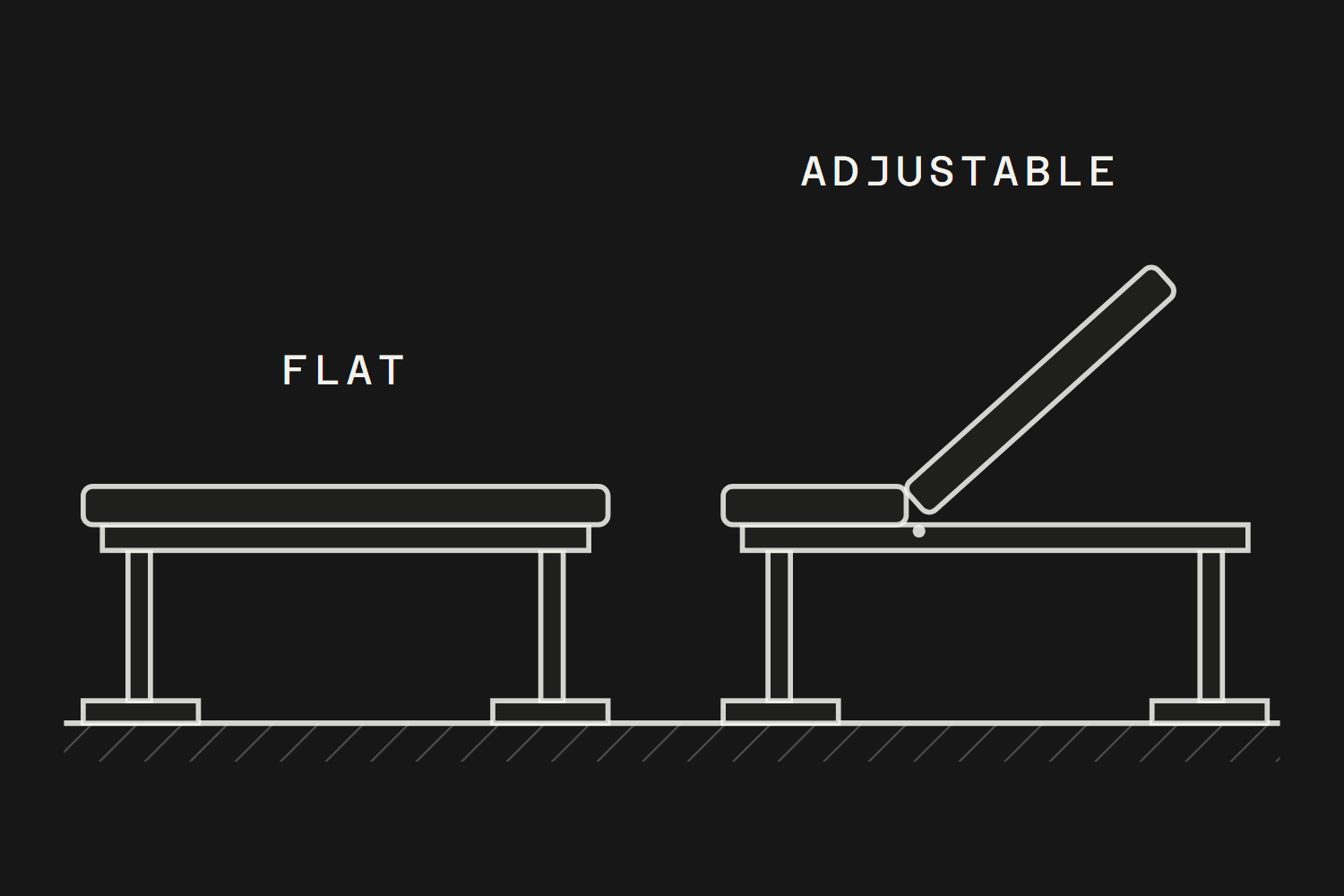
If every exercise in your programme uses a flat bench, a flat bench is the simpler choice. If you need the backrest inclined or declined, you'll need a bench that offers those positions and whose brand allows the exercises you plan.
Neither type is automatically better built. A flat bench isn't always steadier, and an adjustable bench isn't versatile enough for everything just because it adjusts. The individual model's fit, instructions and load figure matter more.
What to consider
- 01
Positions you need
Knowing which backrest and seat positions your exercises use makes benches easier to compare. Adjustable doesn't always include decline.
- 02
Your flat setup
Pad height, usable length, width and any gap when the bench is flat. An incline option doesn't remove the need for a comfortable flat position.
- 03
Moving and storing it
The full base dimensions, the route you'll move it along and the storage position its brand allows, not just a photo of the pad.
- 04
Fit with your rack
Used in a rack, the bench's feet and frame need to clear the rack's base, with the pad sitting where you need it for pressing.
Buying advice
Adjustable benches vary in their angles
The word adjustable doesn't tell you which angles a bench reaches. Rogue's Adjustable Bench 3.0, for example, lists backrest positions from 0 to 85 degrees, with no decline position.Source: Rogue Adjustable Bench 3.0: positions and pad gap
The seat often adjusts separately, and not every combination of seat and backrest angle is allowed. Propping a flat bench on blocks to create an angle it wasn't designed for isn't safe.
The pad you'll lie on
Bench construction affects the surface under you. Rogue describes its Flat Utility Bench 2.0 as a single-piece frame, while its Adjustable Bench 3.0 has separate seat and back pads with a 1-inch (25.4 mm) gap between them. These are construction details, not comfort or stability test results, and both are US products.Source: Rogue Flat Utility Bench 2.0: constructionSource: Rogue Adjustable Bench 3.0: positions and pad gap
Trying a bench unloaded, where possible, shows where the gap falls under your body and whether the pad supports you well. It also shows how the feet sit around your rack and your own feet. A showroom try-out can't confirm the load figure.
Choosing the type first
Settling on the type before comparing extras keeps the choice simple. Where both types meet the same needs, the full price and documented features are a fair comparison; price alone doesn't indicate quality.
- Flat-only training: a good flat bench covers it; an adjustable one is worth it only for another feature you'll use.
- Incline training: the exact model needs the backrest and seat settings you use.
- Decline training: the bench needs a decline position and the leg support its brand specifies.
- Shared room: wheels, handles, turning space and the brand's storage position matter.
- Rack use: the bench's feet need to clear the rack's base, with the pad where you need it.
Conclusion
The right type is the one that gives you the positions your training needs. After that, the individual bench is judged on its fit, construction and instructions; extra angles are only useful if you'll use them.
A good flat bench suits a programme built on flat work, while incline or decline training needs an adjustable model that states those positions. In both cases, the pad, the base and how the bench fits your rack decide how well it works day to day.
Shortlists
Products in our index that meet one stated rule, checked against published specifications. Each list is ordered by name, not ranked, and links to retailers.
Shortlist · Benches
Weight benches with brand-stated wheels
9 of 20 benches qualify
- Horizon Adonis Bench£100 to £250
- York Fitness C19UB Utility Dumbbell Bench with Foot Hold Down£250 to £500
- BodyMax CF325 FID Utility Weight Bench£100 to £250
- and 6 more
Shortlist · Benches
Weight benches that say what their load limit covers
8 of 20 benches qualify
- York Fitness 530 Heavy Duty Multi-Function Barbell Bench£100 to £250
- Horizon Adonis Bench£100 to £250
- York Fitness B500 Folding Barbell Bench£50 to £100
- and 5 more
Sources
Primary references used for factual claims in this guide. Product specifications apply to the named model and version.
- Rogue Adjustable Bench 3.0: positions and pad gap
Rogue Fitness. Accessed 21 Sept 2026.
- Rogue Flat Utility Bench 2.0: construction
Rogue Fitness. Accessed 21 Sept 2026.
Related guides
Benches
3 min read
When to Stop Using, Repair or Replace a Weight Bench
Use the model's instructions and the actual fault to decide what happens next. Age alone is not a replacement schedule.
Benches
2 min read
IPF Bench Dimensions: A Powerlifting Reference
Pad dimensions from the IPF's March 2026 rules, with the measurement conditions that matter when comparing a bench specification.
Benches
3 min read
Weight Bench Load Ratings Explained
Find out whether a quoted figure includes the user, the weights or both. Check independent user limits and the exact model year too.
Benches
2 min read
How to Choose a Home Gym Bench
Check permitted positions, dimensions, capacity definitions and installation before choosing a bench for your training space.