
Barbell Loading Space and Sleeve-Capacity Worksheet
Keep overall bar length, room access and space for plates on each sleeve as three separate checks.
By IRONINDEX · How we research
Introduction
Plates loaded on a standard bar sit within its sleeves, so they don't add to the bar's overall length. You still need room beyond the ends to slide plates on and fit collars.
Sleeve capacity here means the space along the sleeve, not an approved lifting load. The worksheet works best with your actual bar, plates and collars, and keeps installation and load limits as separate checks.
What to consider
- 01
Room space
Overall bar length gives the span the bar occupies. Loading access at each end depends on how you load and the brand's instructions, not a universal allowance.
- 02
Sleeve space
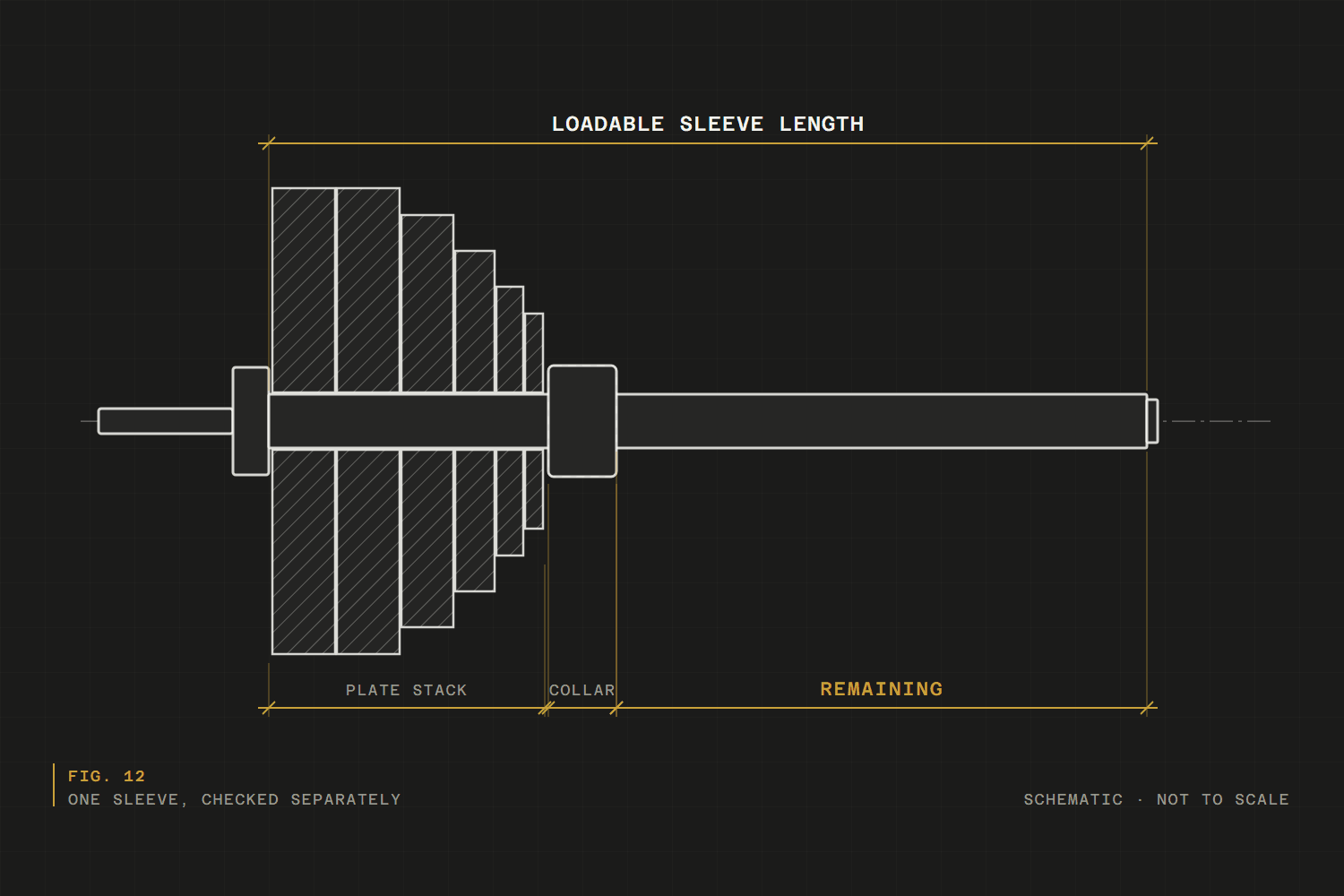
The loadable part of each sleeve, not half the bar's length, including the room the collar needs and any end allowance the brand specifies.
- 03
Uncertain measurements
Tolerances and raised hubs on plates take up space. Plates rarely nest into each other, and a borderline result isn't a fit.
- 04
Load limits
A plate stack that fits the sleeve can still exceed the bar's stated load. That's a separate figure from the brand.
Buying advice
An example of two different bar dimensions
Rogue lists its black-oxide Ohio Bar at 86.75 inches overall, with 16.40 inches of loadable sleeve length. These are specifications for that US model, not universal Olympic-bar dimensions.Source: Ohio Bar, black oxide: gear specifications
Using NIST's exact 25.4mm per inch, those figures convert to 2203.45mm overall and 416.56mm per loadable sleeve. The extra decimal places come from the arithmetic, not from measuring a particular bar.Source: SI Units: Length, exact inch definition
The measurements you need
These fields slot into a room plan. Where a dimension or collar requirement is unknown, the brand can usually supply it, and the decision can wait until it does.
| Attribute | Record for your setup |
|---|---|
| Bar | Exact model; overall length; loadable length of each sleeve, in mm. |
| Plates | Count and axial thickness of each plate on one side, including hubs or protrusions. |
| Collar | Required sleeve engagement and any specified end allowance, in mm. |
| Room | Clear span at the bar's position; access for loading at each end; nearby obstructions. |
Loading-space worksheet
Bar
- Record for your setup
- Exact model; overall length; loadable length of each sleeve, in mm.
Plates
- Record for your setup
- Count and axial thickness of each plate on one side, including hubs or protrusions.
Collar
- Record for your setup
- Required sleeve engagement and any specified end allowance, in mm.
Room
- Record for your setup
- Clear span at the bar's position; access for loading at each end; nearby obstructions.
Checking each sleeve
Plate-stack length = the number of plates of each type × their thickness, added together. Remaining sleeve space = loadable sleeve length − plate-stack length − the collar's required space − any extra end allowance the brand specifies. The same units need to be used throughout, without counting any allowance twice.
A negative result means the plates won't fit in the recorded space. A zero or positive result is only a first check: the actual shape of the plates, tolerances, collar fitting and permitted use still matter. A collar left only partly on the sleeve to squeeze on another plate isn't secure.
The same check applies to the other sleeve. A calculation that fits the plates says nothing about the bar's permitted load, your rack, the floor or your lifting ability.
Conclusion
Three separate answers settle loading space: the bar's overall span in the room, the access needed at each end to load it, and the space the plates and collars take up on each sleeve.
Keeping them apart avoids the two most common mistakes: adding plate thickness to the bar's length, and assuming a sleeve holds more than it does. The bar's stated load is a fourth, separate check.
Shortlists
Products in our index that meet one stated rule, checked against published specifications. Each list is ordered by name, not ranked, and links to retailers.
Shortlist · Weight Plates
Olympic weight plates with a published diameter
12 of 45 plate ranges qualify
- Body Power 107.5 kg Olympic Disc Kit£250 to £500
- Body Power 15 kg Hi-Temp Rubber Crumb Olympic Bumper PlateUnder £50
- Body Power 20 kg Hi-Temp Rubber Crumb Olympic Bumper Plate£50 to £100
- and 9 more
Shortlist · Weight Plates
Olympic weight plates with a published weight tolerance
8 of 45 plate ranges qualify
- Body Power 15 kg Hi-Temp Rubber Crumb Olympic Bumper PlateUnder £50
- Body Power 20 kg Hi-Temp Rubber Crumb Olympic Bumper Plate£50 to £100
- Body Power 5 kg Hi-Temp Rubber Crumb Olympic Bumper PlateUnder £50
- and 5 more
Shortlist · Barbells
Olympic barbells rated to 300 kg or more
9 of 17 bars qualify
- Body Power 6 ft Prestige Olympic Bar£100 to £250
- Body Power 7 ft Olympic Bar, Black Shaft with Chrome Sleeves£50 to £100
- Body Power 7 ft Prestige Olympic Bar£100 to £250
- and 6 more
Shortlist · Barbells
6 ft Olympic barbells for small rooms
4 of 17 bars qualify
- Body Power 6 ft Prestige Olympic Bar£100 to £250
- Body Power 6' Olympic Bar, Fits Olympic Width Equipment (28 mm grip)£50 to £100
- BodyMax 6ft Olympic Barbell£50 to £100
- and 1 more
Sources
Primary references used for factual claims in this guide. Product specifications apply to the named model and version.
- Ohio Bar, black oxide: gear specifications
Rogue Fitness. Accessed 21 Sept 2026.
- SI Units: Length, exact inch definition
NIST. Accessed 21 Sept 2026.