
Gym Equipment Metric and Imperial Conversions
Exact conversion factors for dimensions and plate masses, plus the difference between converting a number and confirming a fit.
By IRONINDEX · How we research
Introduction
The most accurate approach is to convert the stated measurement, keep the original units alongside it and round only the final result. A converted catalogue label doesn't tell you the actual dimensions or tolerances of a part.
What to consider
- 01
Length or mass
Each quantity has its own conversion factor. This page uses lb for mass, not pound-force or a torque figure.
- 02
Nominal or measured
Some listings name a product family, others give an actual measurement. A rounded label can't confirm that an attachment fits.
- 03
Rounding
Rounding only the final answer keeps a calculation accurate. Rounding at each step can make a close fit look better or worse than it is.
- 04
Marked units
Plates marked in pounds and kilograms aren't interchangeable: 45 lb is about 20.41 kg, not 20 kg.
Buying advice
Exact factors
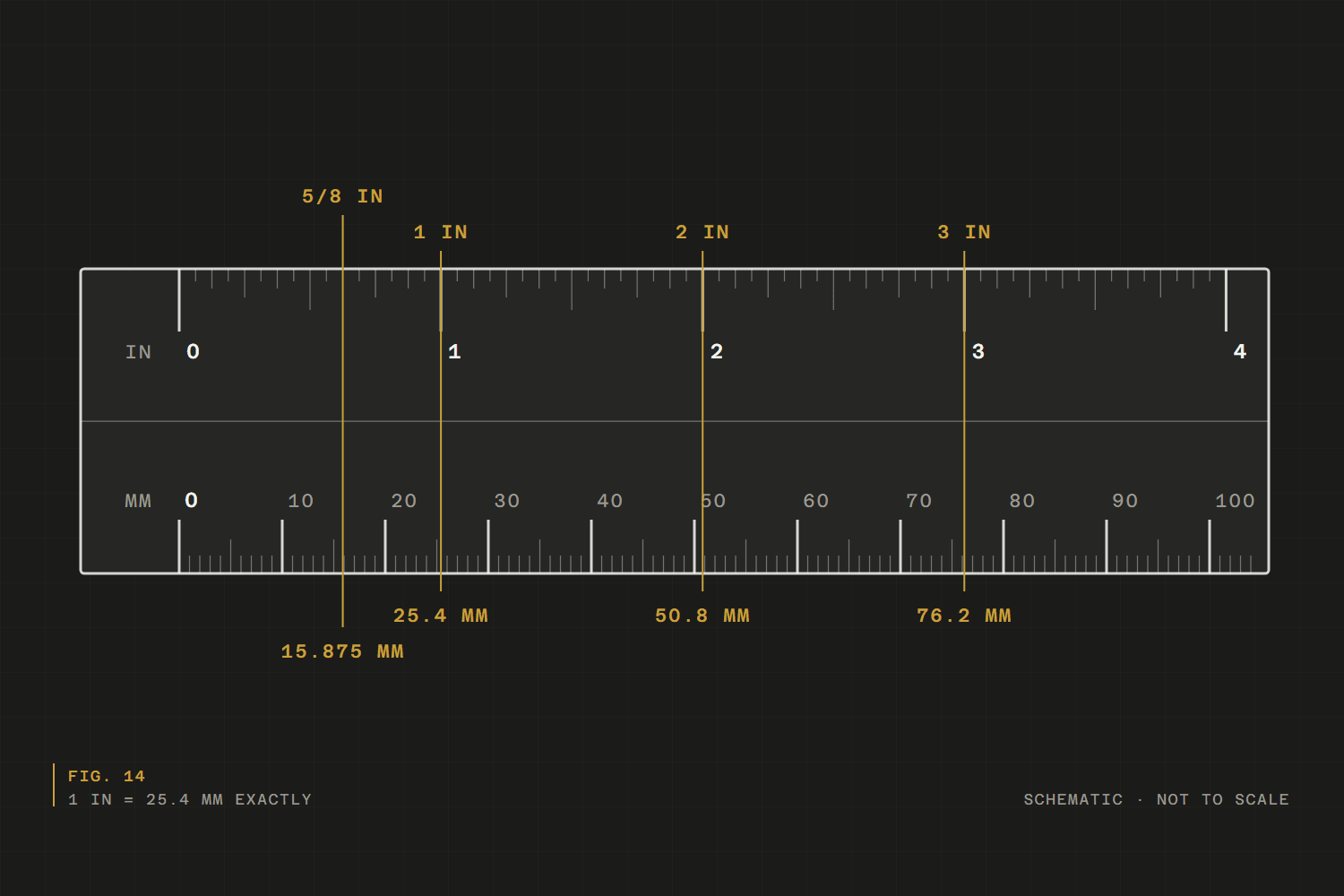
NIST defines one inch as exactly 25.4mm. Its unit tables give the international foot as 0.3048m and the avoirdupois pound as 0.45359237kg. Dividing by the same factor reverses the conversion.Source: SI Units: Length, exact inch definitionSource: Handbook 44 (2023), Appendix C: unit conversions (PDF)
| Attribute | Calculation |
|---|---|
| Inches to mm | Multiply by 25.4. |
| Feet to mm | Multiply by 304.8. |
| Pounds to kg | Multiply by 0.45359237. |
| Kg to pounds | Divide by 0.45359237. |
Conversion rules
Inches to mm
- Calculation
- Multiply by 25.4.
Feet to mm
- Calculation
- Multiply by 304.8.
Pounds to kg
- Calculation
- Multiply by 0.45359237.
Kg to pounds
- Calculation
- Divide by 0.45359237.
Calculated examples
These are arithmetic conversions, not measured products. The length results are exact conversions of the stated numbers; the mass comparisons are rounded to two decimal places.
| Attribute | Converted value |
|---|---|
| 1 inch | 25.4mm |
| 2 inches | 50.8mm |
| 3 inches | 76.2mm |
| 5/8 inch | 15.875mm |
| 7 feet | 2133.6mm |
| 45lb | Approximately 20.41kg |
| 20kg | Approximately 44.09lb |
Common equipment-unit comparisons
1 inch
- Converted value
- 25.4mm
2 inches
- Converted value
- 50.8mm
3 inches
- Converted value
- 76.2mm
5/8 inch
- Converted value
- 15.875mm
7 feet
- Converted value
- 2133.6mm
45lb
- Converted value
- Approximately 20.41kg
20kg
- Converted value
- Approximately 44.09lb
Converting isn't the same as confirming a fit
A true 3-inch measurement converts to 76.2mm, not 75mm. That arithmetic alone can't tell you whether a bracket fits: the actual upright, lining, pins and approved setup still need checking.
Likewise, 45lb and 20kg are different masses. It helps to record what each plate is marked in, rather than treating one as the other because they sit in similar places in a range. Weight accuracy is a separate specification again.
Unrounded numbers keep a clearance calculation honest. More decimal places in the answer don't make a rounded catalogue figure more precise, so a borderline result calls for the actual dimension and its tolerance.
Conclusion
Conversions put figures into the same units so they can be compared. They can't tell you whether two products fit together.
For fit, the brand's actual measurements and compatibility statements are what count. A rounded label converted to metric is still a rounded label, so a close result calls for the real dimension.
Sources
Primary references used for factual claims in this guide. Product specifications apply to the named model and version.
- SI Units: Length, exact inch definition
NIST. Accessed 21 Sept 2026.
- Handbook 44 (2023), Appendix C: unit conversions (PDF)
NIST. Accessed 21 Sept 2026.