
How Much Clearance Does a Power Rack Need?
Measure the rack, bar, bench, attachments and access routes in use. There is no single spare-space figure that covers every setup.
By IRONINDEX · How we research
Introduction
A power rack needs enough room to assemble, load and use in the setup its instructions allow. Its footprint covers only part of that. The ends of the bar, a bench being moved in and out, or plate storage on the sides can set the real limits.
The rack brand's own clearance figures are the place to start. After that, it helps to map your equipment and movements in the room itself, without trimming a stated minimum because the empty frame happens to fit.
What to consider
- 01
Width
The full bar length, room to load both sleeves and any plate storage on the sides. Walls, radiators and door handles can get in the way at bar height.
- 02
Depth
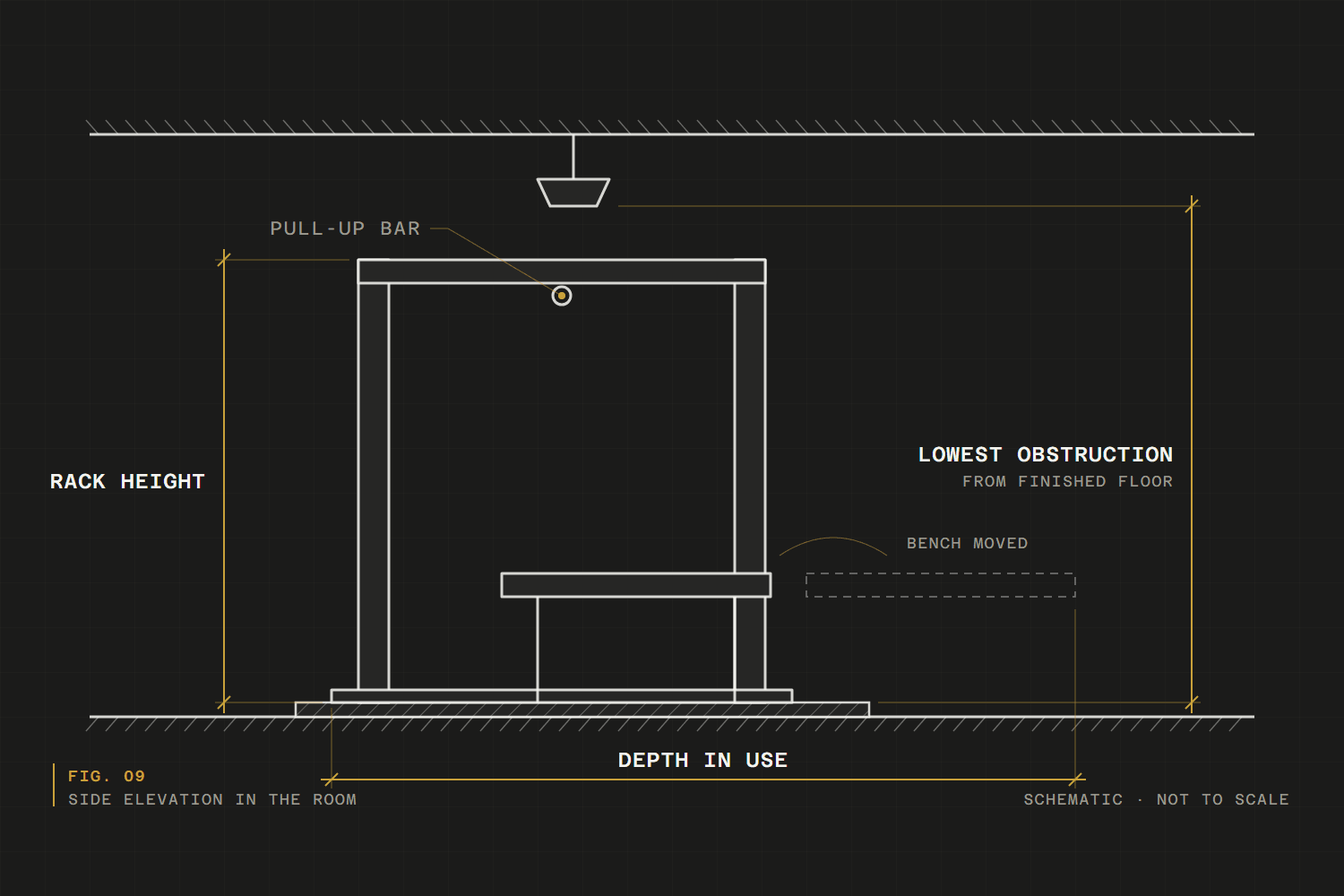
Room for the bench in use and while moving it, any rear attachments and getting in and out of the rack. Internal depth isn't the full footprint.
- 03
Height
From the finished floor, including mats or a platform, to the lowest obstruction above. Pull-ups and overhead lifts reach higher than the frame.
- 04
Getting it in
Long uprights have to get through doors and up stairs, and some parts need room to be lifted and turned into place during assembly.
Buying advice
Measuring the whole setup, not the bare frame
Attachments can change a rack's footprint a lot. Decathlon lists its Power Rack 900 at 1.22 m wide without disc holders and 1.75 m wide with two fitted. That's before adding the bar or room to handle plates.Source: Decathlon Power Rack 900 support and specifications
The bar is often wider than the rack. Mirafit lists its M3 20 kg bar at 2.2 m long. Plates sit on the sleeves, so they don't make the bar longer, but you still need space beyond each end to slide them on and off.Source: Mirafit M3 20kg barbell specifications
These are separate brand examples, not a matched rack and bar. Where a drawing leaves out an attachment's projection, the brand may be able to give the assembled dimensions.
Checking the room at working height
The narrowest usable width is what matters, not wall-to-wall at floor level. A radiator may clear the rack's feet but get in the way of a plate. A garage door track may sit above the uprights yet interfere with a pull-up or a bar held overhead.
Doors need checking in every position you'll use while training, along with lights, beams, sockets you need to reach and your way out of the room. Training with a shared doorway blocked isn't a reliable plan.
Height is measured from the surface the rack will stand on once mats or a platform are down. Assembly can need extra height too: a part that fits once fitted may need room to be lifted and turned into place.
Mapping movement as well as footprint
Masking tape on the floor showing the rack, bench and bar ends is a simple way to spot conflicts. Walking through setting up the bench, reaching the sleeves and putting plates away, without any weight, reveals most problems. A tape outline helps find clashes, but it doesn't replace the brand's stated clearances.
The highest point of each movement needs checking separately. The height of the pull-up bar isn't the height your head reaches during a pull-up, and the rack's height doesn't tell you whether there's room to press a bar overhead. If you're unsure, an in-person check with a coach is safer than testing with a loaded bar.
Measurements worth recording before you order
Keeping these on one sheet makes racks easy to compare. Any figure you can't find is a question for the seller, not something to guess.
- Room: narrowest clear width, usable depth and lowest obstruction above the finished floor.
- Rack: full width, depth and height with feet, bolts and top attachments.
- Bar and plates: overall length, loading access and access to storage.
- Bench and accessories: positions in use and the route for moving them.
- Installation: delivery route, assembly space and access to fixings.
- Instructions: the model's clearance requirements and any open questions for the seller.
Conclusion
Clearance is the space your whole setup needs in use: the rack, the bar, the bench and the movements you'll do. A rectangle around the rack's feet covers only part of it, and height is often the measurement that rules a rack out.
The rack brand's stated clearances are the starting point. Where a dimension is missing, it's worth getting it from the seller before ordering rather than relying on a general rule.
Shortlists
Products in our index that meet one stated rule, checked against published specifications. Each list is ordered by name, not ranked, and links to retailers.
Shortlist · Racks
Squat racks that publish their footprint
5 of 8 racks qualify
- BodyMax CF375 Power Rack£250 to £500
- BodyMax CF470 Heavy Half Power Rack£250 to £500
- BodyMax CF475 Power Rack£250 to £500
- and 2 more
Shortlist · Racks
Squat racks with a built-in pull-up bar
5 of 8 racks qualify
- BodyMax CF375 Power Rack£250 to £500
- BodyMax CF470 Heavy Half Power Rack£250 to £500
- BodyMax CF475 Power Rack£250 to £500
- and 2 more
Sources
Primary references used for factual claims in this guide. Product specifications apply to the named model and version.
- Decathlon Power Rack 900 support and specifications
Decathlon. Accessed 24 Sept 2026.
- Mirafit M3 20kg barbell specifications
Mirafit. Accessed 24 Sept 2026.