
How to Choose a Power Rack
Start with installation and the lifts you need to accommodate. Then compare usable space, safeties, attachments and the complete package.
By IRONINDEX · How we research
Introduction
The quickest way to choose a power rack is to rule out the ones you can't install or use properly in your room. A high load figure doesn't help if the rack needs floor bolts you can't fit, leaves no room for your bench or comes without suitable safeties.
Three things make the comparison easier: the barbell lifts you plan to do, your room measurements and the equipment you already own. This guide assumes you've settled on a full cage; the squat rack versus power cage guide covers that earlier choice.
What to consider
- 01
Installation first
Some racks must be bolted to the floor, and others stand freely only in certain setups. The exact model's instructions say which, and whether that works in your home.
- 02
Usable interior
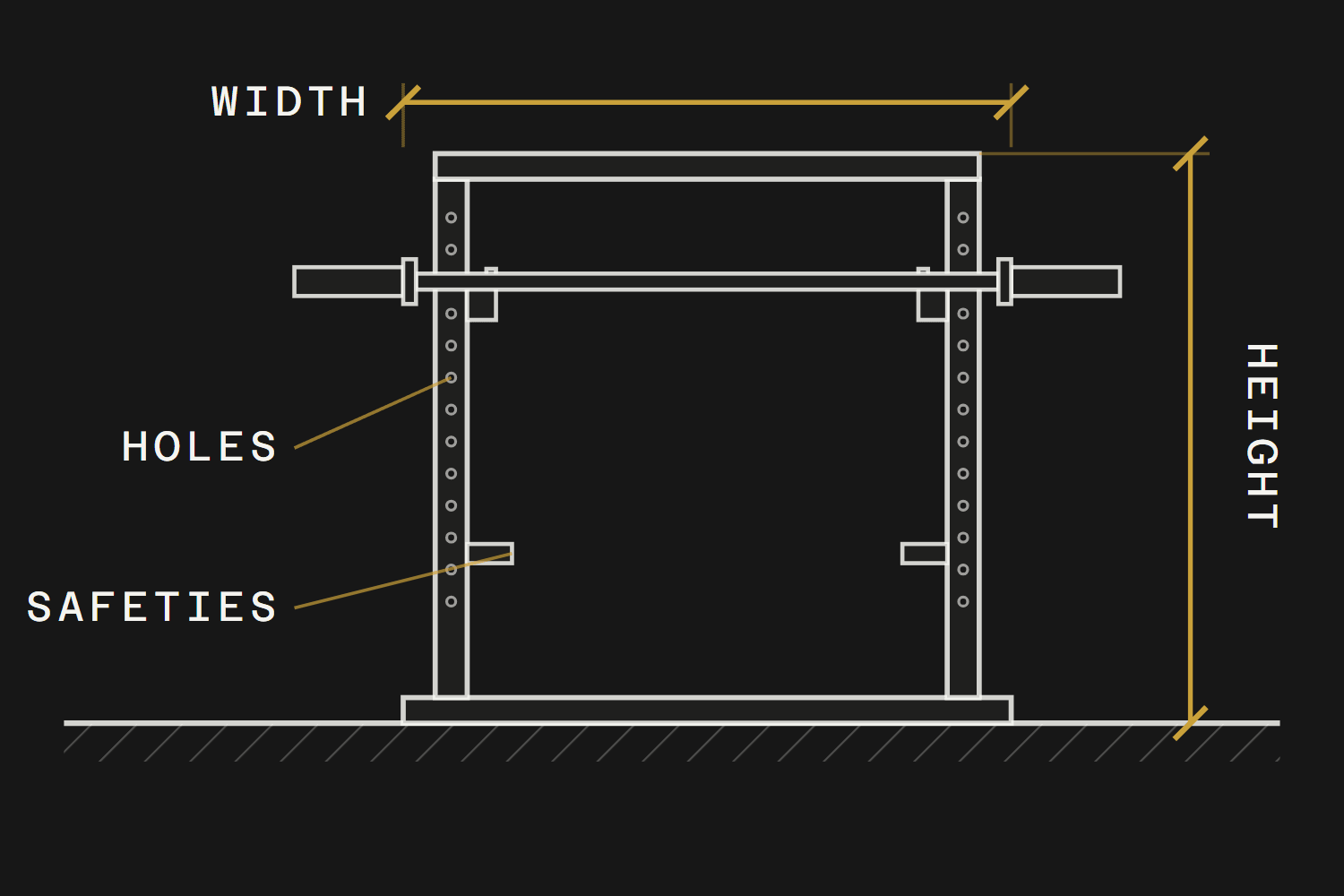
The space between the uprights decides whether your bench fits and your bar has room. Outside dimensions describe the frame, not the space inside it.
- 03
Safeties
Safety arms, pins or straps catch the bar if you can't finish a lift. The type supplied, whether it suits the rack's depth and how finely it adjusts all matter.
- 04
The complete package
J-cups, safeties, locking pins, stabilisers, delivery and assembly can each add to the price. A quote that includes all of them is the fair one to compare.
Buying advice
Floor fixing comes first
Racks differ in how they must be fixed down, and this can rule a model out before anything else. Some must be bolted to the floor in every setup; others are designed to stand freely, or only in particular configurations. Mirafit, for example, says its M3 rack must be bolted down, except the 90 cm-deep version fitted with the optional rear stabiliser.Source: Mirafit M3 rack: dimensions and installation notes
If drilling into your floor isn't possible, the racks worth considering are those the brand designs to stand without fixings in the setup you'll use. Loading plates onto the rack's storage isn't a substitute the brand has approved for floor bolts. Whether a floor can take a rack is a question for a qualified professional, not the rack's load figure.
Fitting the bar, bench and safeties together
A rack has to work with the rest of your equipment. Comparing the rack's internal width and depth with your bench's dimensions shows whether the bench's feet clear the crossbars at the bottom of the rack. For incline pressing, the bench needs checking at that angle, not only flat.
J-cups and safeties also need to adjust to the heights you use. A rack with wider hole spacing may not have a position close enough to the height you need, which is why some racks use closer spacing around bench height. If the drawings leave a clash unclear, the seller can usually confirm it.
This is a fit check rather than coaching on catching a failed lift. The rack's instructions explain how its safeties are set up and used, and a coach can help if you're unsure where to set them for each exercise.
Reading load figures
A single headline load figure can hide important detail. Decathlon's Power Rack 900, for instance, lists separate limits for its bar holders (200 kg in total, or 100 kg each) and its pulley (100 kg).Source: Decathlon Power Rack 900 support and specifications
For any rack, it's worth asking what each figure covers and in which setup. The frame, J-cups, safety straps, spotter arms and cable attachments rarely share one rating. A load figure also isn't permission to drop a loaded bar onto any of them unless the brand says so.
Comparing the full price
Racks are often advertised as a bare frame, with essentials sold separately. An itemised quote makes it possible to compare like with like, and an attachment is best treated as a future option only once its fit and extra space are confirmed.
- The frame in the height and depth you need, with assembly instructions.
- J-cups and a safety system that suit that frame.
- Any stabilisers, floor fixings and fitting work the brand requires.
- Delivery to the room, including stairs or narrow doors.
- Any attachments you plan to add, with the extra space they take up.
Conclusion
A good rack for your home is one you can install as its brand intends, that fits your bar and bench, and that comes with the safeties you need. Steel thickness and a headline load figure matter less than those three points.
The fixing question usually narrows the choice the most, so it's the best place to start. After that, the inside dimensions and adjustment can be checked against your equipment, and prices compared on the complete package rather than the bare frame.
Shortlists
Products in our index that meet one stated rule, checked against published specifications. Each list is ordered by name, not ranked, and links to retailers.
Shortlist · Racks
Squat racks with a built-in pull-up bar
5 of 8 racks qualify
- BodyMax CF375 Power Rack£250 to £500
- BodyMax CF470 Heavy Half Power Rack£250 to £500
- BodyMax CF475 Power Rack£250 to £500
- and 2 more
Sources
Primary references used for factual claims in this guide. Product specifications apply to the named model and version.
- Mirafit M3 rack: dimensions and installation notes
Mirafit. Accessed 21 Sept 2026.
- Decathlon Power Rack 900 support and specifications
Decathlon. Accessed 21 Sept 2026.
Related guides
Racks
3 min read
Rack Hole Spacing Explained
Hole spacing sets the available adjustment positions. Hole diameter, pin diameter and upright size answer different questions.
Racks
3 min read
Why Rack Attachments Are Not Universally Compatible
Matching a pin to a hole is only one check. The bracket, upright, mounting position and approved rack configuration matter too.
Racks
3 min read
What to Check Before Buying a Used Power Rack
Match the frame, safeties and hardware to the correct instructions, then confirm that the installation will work in your room.
Racks
4 min read
How Much Clearance Does a Power Rack Need?
Measure the rack, bar, bench, attachments and access routes in use. There is no single spare-space figure that covers every setup.
Racks
3 min read
Squat Rack vs Power Cage: What's the Difference?
Squat stands, half racks and power cages all hold a barbell. How they catch it when things go wrong is what separates them.