
Squat Rack vs Power Cage: What's the Difference?
Squat stands, half racks and power cages all hold a barbell. How they catch it when things go wrong is what separates them.
By IRONINDEX · How we research
Introduction
The names get used loosely, even by retailers, which doesn't help. A listing called a squat rack might be two independent stands, a half rack or a full cage.
Rather than rely on the name, look at the structure: how many uprights it has, how they're connected and what safety system it uses. That tells you what it's really for.
What to consider
- 01
Training alone
Training alone makes the safety system the key feature: which arms, pins or straps the brand permits, how far they adjust and how the rack must be installed.
- 02
Footprint
Names don't determine size. The outside dimensions, the space needed in use and any projecting feet or attachments vary between exact models.
- 03
Stability
Each model has its own assembly and anchoring instructions. A retailer photo showing no fixings doesn't mean a rack is freestanding.
- 04
Attachments
Many racks accept dip bars, landmine attachments or cable add-ons, but usually only from the same brand or hole pattern.
Buying advice
Squat stands
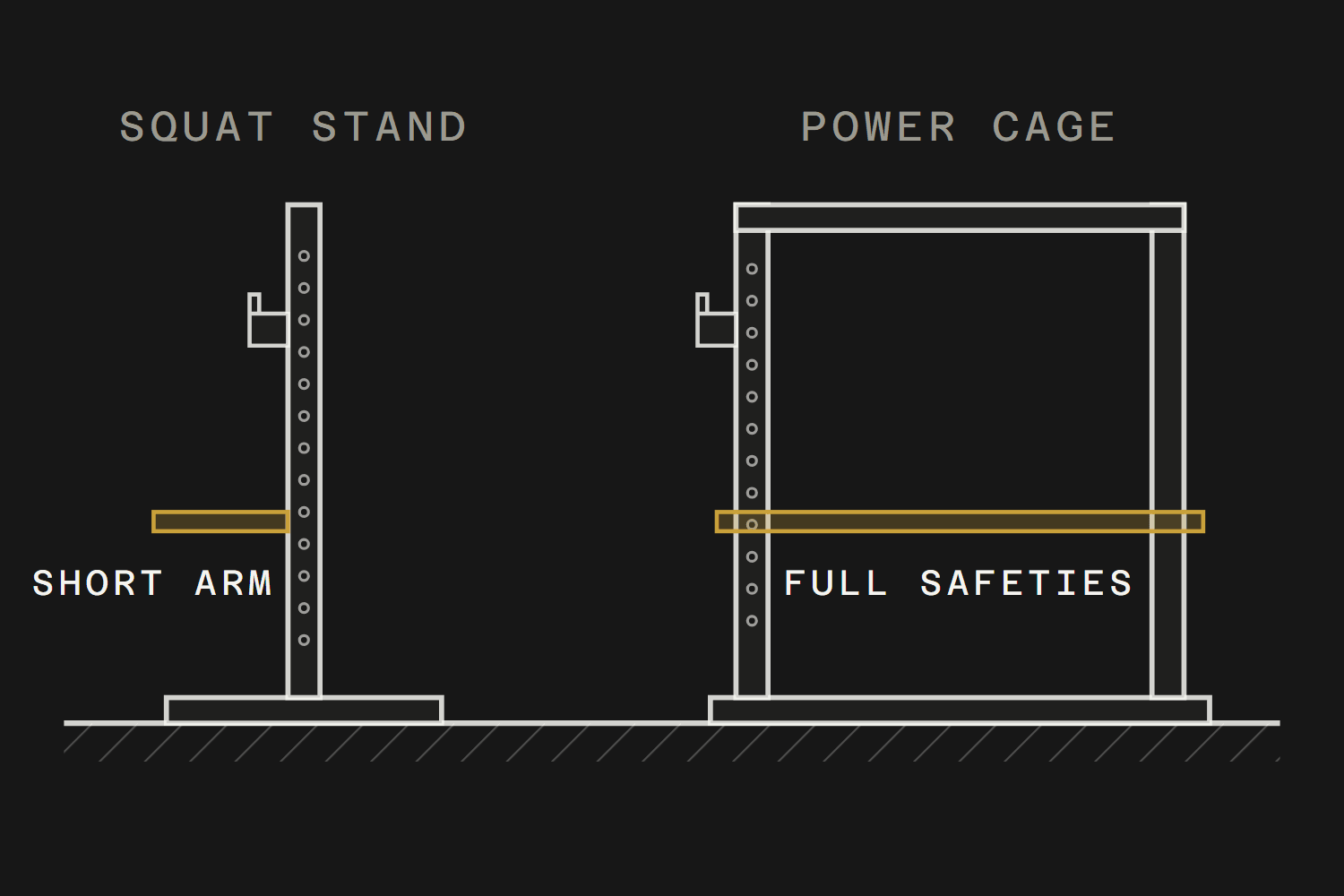
Two separate uprights, each with a J-hook to hold the bar. Some are joined at the base, some are fully independent.
They're compact, cheap and easy to move, which makes them popular in small spaces. The downside is safety: many have short spotter arms or none at all, and independent stands can be knocked out of line.
Stands suit only the exercises and loads their brand permits, with the specified safety equipment. Independent uprights also need careful alignment before use.
Half racks
Two uprights joined into a single frame, often with a base extending back. You train in front of the uprights with spotter arms sticking out towards you.
They're a middle ground: more stable than stands, smaller than a cage, and many include a pull-up bar.
Power cages
Four uprights forming a box. You step inside and set safety pins, straps or bars at a height just below the bottom of your lift.
A cage can place adjustable safeties on both sides of the lifter, but protection depends on the right height, compatible parts, installation and use. Practising with an unloaded bar, following the manual, is a good way to learn how to set them.
The trade-off is size. Cages are bigger, heavier and taller, so ceiling height needs checking carefully.
Which one should you get?
The safety system and installation you can use correctly are the best starting point. After that, room requirements, stated capacities and attachment support narrow the choice. A cage isn't automatically right for every room or every exercise.
If space points you towards stands or a folding rack, the approved safety arms, anchoring and clearances are worth confirming before treating the smaller footprint as the answer.
Conclusion
Squat stands, half racks and power cages differ mainly in how they're built and how they catch a bar you can't lift. The name on a listing is only a starting point, since retailers use the terms loosely.
Comparing the frame, the safety system the brand approves, the installation it needs and the space it takes up gives a clearer answer than the product name. For training alone, the safety system deserves the closest look.
Shortlists
Products in our index that meet one stated rule, checked against published specifications. Each list is ordered by name, not ranked, and links to retailers.
Shortlist · Racks
Squat racks with a built-in pull-up bar
5 of 8 racks qualify
- BodyMax CF375 Power Rack£250 to £500
- BodyMax CF470 Heavy Half Power Rack£250 to £500
- BodyMax CF475 Power Rack£250 to £500
- and 2 more
Related guides
Racks
3 min read
Why Rack Attachments Are Not Universally Compatible
Matching a pin to a hole is only one check. The bracket, upright, mounting position and approved rack configuration matter too.
Racks
4 min read
How to Choose a Power Rack
Start with installation and the lifts you need to accommodate. Then compare usable space, safeties, attachments and the complete package.
Home Gym
3 min read
How Much Space Do You Need for a Home Gym?
Measure the equipment, the room and the space required to use it. A footprint alone does not tell you whether a setup works.
Home Gym
2 min read
Free Weights vs Machines for Home Use
Both build muscle. At home, space, budget and training alone change which one makes more sense.